Apples to Oranges: Are Robot Sports Records Really Comparable to Humans?
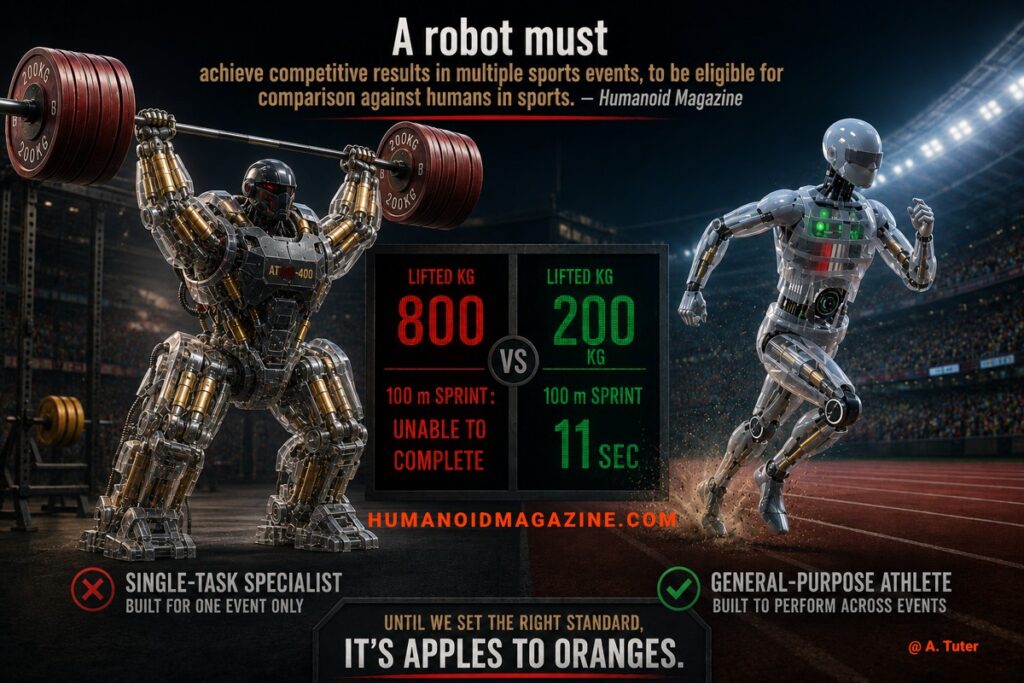
The World Humanoid Robot Games are in full swing, with headlines declaring robots running faster than Usain Bolt in the 100m or clearing nearly three meters from a standing jump. But let’s call this what it is: an apples-to-oranges comparison.
When you optimize a machine for a single specific task, beating a human record becomes much less surprising.
Moravec’s paradox in AI helps explain part of this: tasks that seem intellectually difficult to humans, such as chess, can be relatively easy for machines, while the seemingly simple sensorimotor abilities required to operate in the physical world remain extraordinarily difficult to reproduce. That is not the same claim as “a specialist beat a record.” Chess versus a brain is Moravec. A sprint robot versus Bolt is a different problem: single-function hardware being scored as if it were a general-purpose body.
The real comparison would be a robot with body proportions and mass distribution similar to ours, able to perform in multiple sports, competing against us. That would be apples to apples.
For example, an android able to compete in a decathlon, which requires different abilities in each event. A robot built for one specific task cannot do that.
There is a fundamental difference between single-function specialization and general-purpose engineering.
Our bodies are general-purpose constructions. They were not originally made for just the 100m sprint, boxing, swimming, or high jump. You can’t compare a human with a machine built only for swimming, weightlifting, or high jump. That is similar to comparing the human brain to a chess robot and calling the chess robot more intelligent. Or comparing human strength to a bulldozer. It doesn’t work that way.
Human athletes specialize too, yes, but they do so using a general-purpose body. Our anatomy wasn’t engineered solely for sprinting, swimming, or weightlifting; it is a multi-use platform designed to balance power, endurance, flexibility, and recovery. A true apples-to-apples comparison requires hardware built under the same general-purpose constraints as the human body.
The numbers are impressive — but are they comparable?
This week’s results make the mismatch concrete.
Tiangong Ultra ran the 100m in 9.39 seconds in a preliminary heat and later improved to 8.86 seconds in the semifinal before winning the final in 8.64 seconds. Honor’s Lightning ran 9.47 seconds in an official heat and had previously recorded 9.32 seconds in a test. Tiangong Ultra also won the 400m in 38.15 seconds. These are outstanding engineering results.
But even the headline numbers need context.
The robots are competing under the rules and conditions of the World Humanoid Robot Games, not World Athletics. The times therefore aren’t new World Athletics records, even though they are faster than the corresponding human world-record times.
And then there is the stopping problem. Several robots struggled to stop after high-speed runs, with padded barriers used to bring them to a halt. In one incident, a robot hit a barrier and caught fire.
Lightning’s legs were also lengthened by 10 cm after its April half-marathon appearance for these Games.
The much-cited 2.88m high-jump figure has an even bigger comparability problem. It was a standing jump. Javier Sotomayor’s 2.45m human record is a running high jump, using the Fosbury flop.
The physics of trade-offs
Human body architecture is a masterclass in compromise. Tendon compliance, muscle-fiber distribution, and joint geometry are balanced so we can sprint, swim, endurance-run, and throw.
A robot designed purely to sprint can use rigid, hyper-specialized actuators and lightweight alloys optimized for a particular type of movement. Subjecting that same machine to a high jump or a shot put could place loads on its actuators and structure that they were never designed to withstand.
Energy density and thermal limits matter too. A single-event specialized robot can vent heat or dump peak power for 9 seconds in a 100m dash without worrying about battery and actuator survival over a 10-event span. Multi-event testing forces energy efficiency into the equation.
Single-event robots can also exploit highly specialized mass distribution — for example, placing heavy motors directly at the joints if that configuration benefits sprinting — whereas a multi-event humanoid has to accommodate structural mass and components that may not be optimal for every event, balancing structural rigidity for throwing events with low rotational inertia for running.
Software adaptability vs. dynamic control
Single-discipline demonstrations can often rely on motion profiles tuned specifically for one set of conditions.
Multi-event athletic environments demand something different: real-time motor adaptation and control algorithms that can switch from high-impact dynamic jumping to precision movement without breaking stride.
A robot that can run extremely fast is impressive.
A robot that can run extremely fast, then throw a heavy object, then jump, then maintain balance, then perform precise manipulation, and repeat the process across many different environments is a much harder engineering problem.
That is the distinction we are talking about.
Bottom line
We are not saying robot achievements are meaningless. They are outstanding results, reached through the hard work of many talented engineers and other professionals. To compare humans and robots in sports, however, we need defined criteria.
Here is a proposal by Humanoid Magazine:
A robot must achieve competitive results in multiple sports events, to be eligible for comparison against humans in sports.
A decathlon requirement forces hardware engineers to tackle the ultimate robotics challenge: multi-modal mechanical efficiency, adaptable control algorithms, and structural durability across varied kinetic loads.
While decathlon is a great benchmark for humans, humanoid robotics might also benefit from testing dynamic adaptability — for example, executing sports that require rapid environmental reaction and complex balance adjustment, like tennis or parkour, alongside pure athletic metrics such as running and jumping.
Organizers of humanoid competitions — or an independent standards body — should define exact standardization criteria for a “Humanoid Decathlon”. For example, establishing a strict scoring framework that requires zero physical hardware swaps — no changing limbs, grippers, actuators, or other major components — between events.
That last rule is the one that makes the comparison real.
Same body. Same hands. Same mass distribution. Several sports that punish each other.
The goal isn’t to force robots to copy human biology. It is to prevent a machine from being purpose-built around the requirements of a single event and then presenting its specialized performance as evidence that it has surpassed the general-purpose human body.
Until then, a machine that beats Bolt on Saturday and cannot handle a light barbell on Monday is a specialist in a humanoid costume — not an athlete in the human sense.
Post By: A. Tuter
Terms of Use: Unauthorized copying is prohibited; we maintain dated records to document original publication. Content may contain inaccuracies. All trademarks mentioned belong to their respective owners; we are not affiliated with them, and no endorsement is implied. See our Terms Page.